Wheel Ceramic Coating in Bolton, Greater Manchester
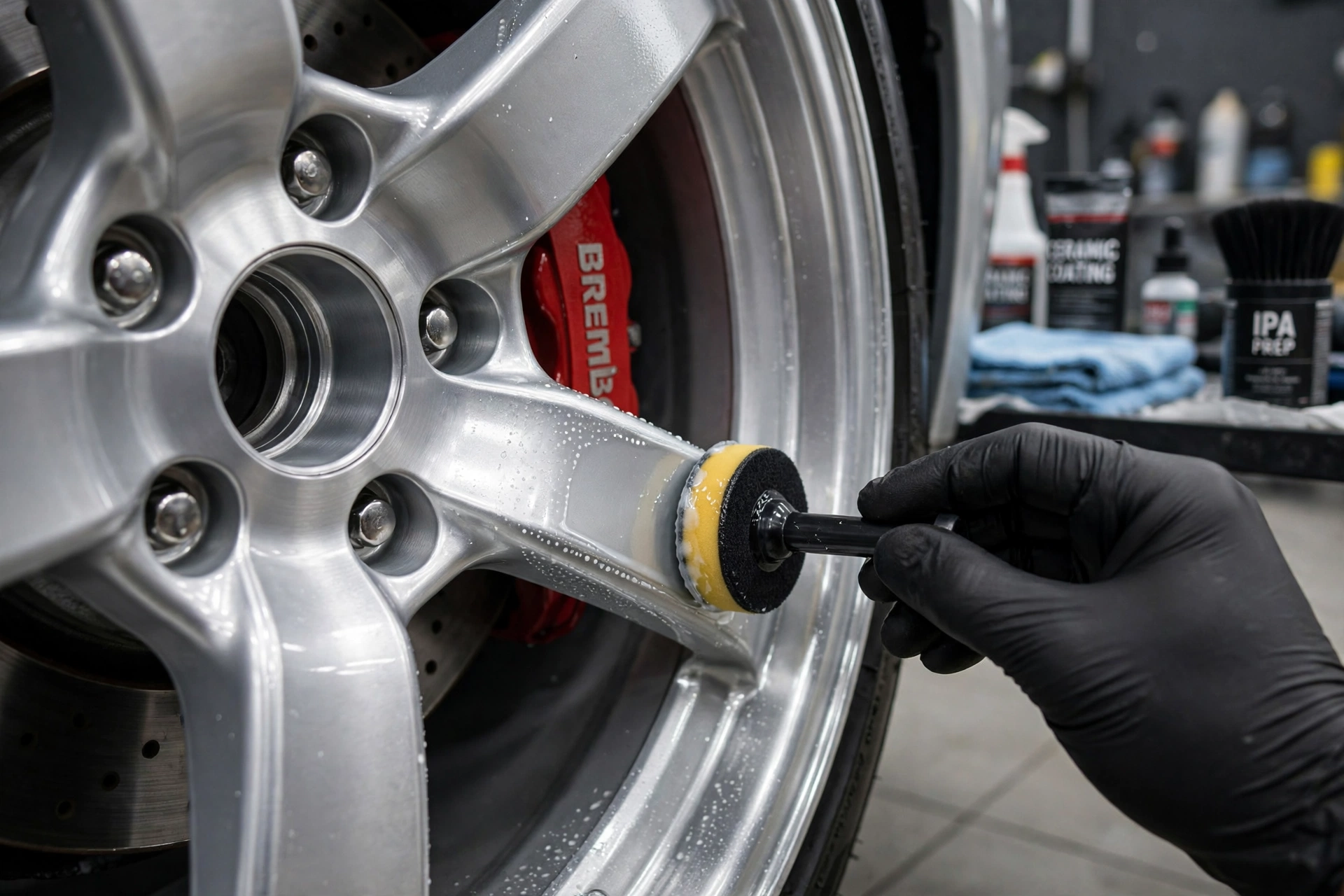
Wheel ceramic coating is a coating applied to alloy wheels and calipers that repels brake dust, road salt and tar, making wheels easier to clean. Instead of contamination baking onto the finish, it sits loosely on the surface and rinses away with washing. For Bolton drivers facing winter gritting and M61 brake-dust film, it's one of the best upgrades available.
Key facts
- Durability
- Typically one to two years — wheels endure far more heat and chemical abuse than bodywork.
- Repels
- Brake dust, road salt and tar sit loosely on the coating instead of baking onto the finish.
- Process
- 5-step process; best applied with wheels off the car so faces, barrels and inner rims are protected.
- Aftercare
- Wash with pH-neutral shampoo and a soft brush; avoid acidic wheel cleaners.
Wheels take more punishment than any other part of your car. Every journey coats them in hot brake dust — fine iron particles that bake onto the finish — plus road salt, tar and general grime. Left unprotected, alloy wheels develop baked-on contamination that's miserable to remove and can permanently dull or pit expensive finishes like diamond-cut faces. Wheel ceramic coating changes that equation completely — for good.
A dedicated, heat-resistant ceramic coating is applied to the wheel faces, barrels and optionally the brake calipers, creating a slick, chemical-resistant surface that brake dust simply can't grip. Cleaning becomes a matter of rinsing and a gentle wash rather than scrubbing with harsh wheel acids. For drivers who've battled brown, dusty wheels every single week, the difference feels almost unfair.
Why Wheels Suffer More Than Bodywork
Brake dust is uniquely hostile. It's hot when it lands, it's rich in iron and carbon, and it bonds fast — especially to warm wheels after a motorway run down the M61. Add winter road salt, which accelerates corrosion on unprotected or kerbed alloys, and tar flicked up from the A666, and wheels face a chemical assault the bodywork never sees.
Diamond-cut and polished finishes are the most vulnerable: once brake dust etches into the lacquer, the damage is permanent without a refurbishment. A ceramic coating puts a sacrificial, chemical-resistant barrier between those finishes and everything the road throws at them.
How Wheel Ceramic Coating Fights Brake Dust
The coating works on the same principle as on paintwork — but the formulation is built for heat. Applied to meticulously cleaned and decontaminated wheels, it cures into a slick layer that iron particles and road salt can't bond to. Brake dust still lands on the wheel, but it sits loosely on the surface instead of baking in.
- Brake dust rinses off instead of baking on
- Road salt and winter grime release with gentle washing
- No more harsh acidic wheel cleaners needed
- Tar spots wipe away instead of sticking
- Gloss and depth preserved on polished and diamond-cut finishes
Brake Caliper Coating: The Finishing Touch
Coated calipers are the detail that completes the job — especially behind open-spoke wheel designs where the caliper is on show. Brake calipers live in the harshest environment on the car: extreme heat cycling, constant dust and direct salt spray. A high-temperature ceramic coating keeps them looking fresh and makes them wipe-clean, rather than gradually turning a permanent shade of brown-grey.
Caliper coating is usually booked alongside wheel coating, since the wheels are already off the car. It's a small addition to the job that makes a disproportionate difference to the overall look — clean, vivid calipers behind glossy coated wheels.
How Long It Lasts and How to Maintain It
A professional wheel coating typically protects for one to two years — less than bodywork coatings, because wheels endure far more heat and chemical abuse. That's still transformative compared with unprotected wheels. Maintenance is simple: wash wheels with pH-neutral shampoo and a soft brush, avoid acidic wheel cleaners, and the coating will keep releasing brake dust wash after wash.
We recommend coating wheels when they're already off the car or during a full detail, so faces, barrels and inner rims all get protected — brake dust collects everywhere, not just where you can see it. It costs little extra at that point and means every surface stays easy to clean.
Our Wheel Ceramic Coating Process
Wheels get the same meticulous preparation as bodywork — because the coating is only as good as the surface beneath it.
- 1
Wheels-off deep clean
Where possible we remove the wheels for full access. Faces, barrels and inner rims are deep-cleaned with iron fallout remover, tar remover and gentle agitation to strip every trace of baked-on brake dust and old dressings.
- 2
Decontamination and clay
Any remaining bonded contamination is removed with a clay bar treatment, leaving the alloy perfectly smooth. Ceramic coating bonds to clean metal and lacquer — contamination left behind would compromise the bond and get sealed in.
- 3
Machine polishing (where needed)
Light defects in the wheel lacquer are machine polished out to restore gloss before coating. Heavily kerbed or corroded wheels may need refurbishment first — we'll always tell you honestly if polishing isn't enough.
- 4
Panel wipe and coating application
The wheels are wiped down to remove all residues, then the heat-resistant ceramic coating is applied to faces, barrels and calipers as booked. Each section is carefully levelled for an even, high-gloss cure.
- 5
Cure and refit
Wheels are left to begin curing before refitting, torqued to the manufacturer's specification. We advise a short curing window before the first wash, then hand over simple aftercare guidance for keeping them pristine.
Trusted further reading
- Halfords — How to clean alloy wheels — Wheel care that protects coatings
Serving Bolton & Greater Manchester
Bolton's winter gritting is brutal on alloy wheels — salt spray from treated roads around the town centre, the A666 and the M61 corridor bonds to unprotected rims within weeks. Add year-round brake dust from stop-start commuting through Farnworth, Kearsley and Walkden, and local wheels take a hammering. We coat wheels for drivers across Bolton and Greater Manchester, and the feedback is always the same: cleaning goes from a dreaded chore to a five-minute rinse.
Areas we serve
BoltonHorwichFarnworthKearsleyLittle LeverWesthoughtonBlackrodAdlingtonBuryRadcliffeRamsbottomTottington
View all areas covered →Frequently asked questions
How long does wheel ceramic coating last?
Is wheel ceramic coating worth it?
Can you ceramic coat brake calipers?
Does wheel coating work on diamond-cut alloys?
How much does wheel ceramic coating cost?
Get your free, no-obligation quote
Tell us about your car and what it needs. We'll reply with an exact price and the earliest available slot.
Open 24 hours, 7 days a week — call or message any time.